
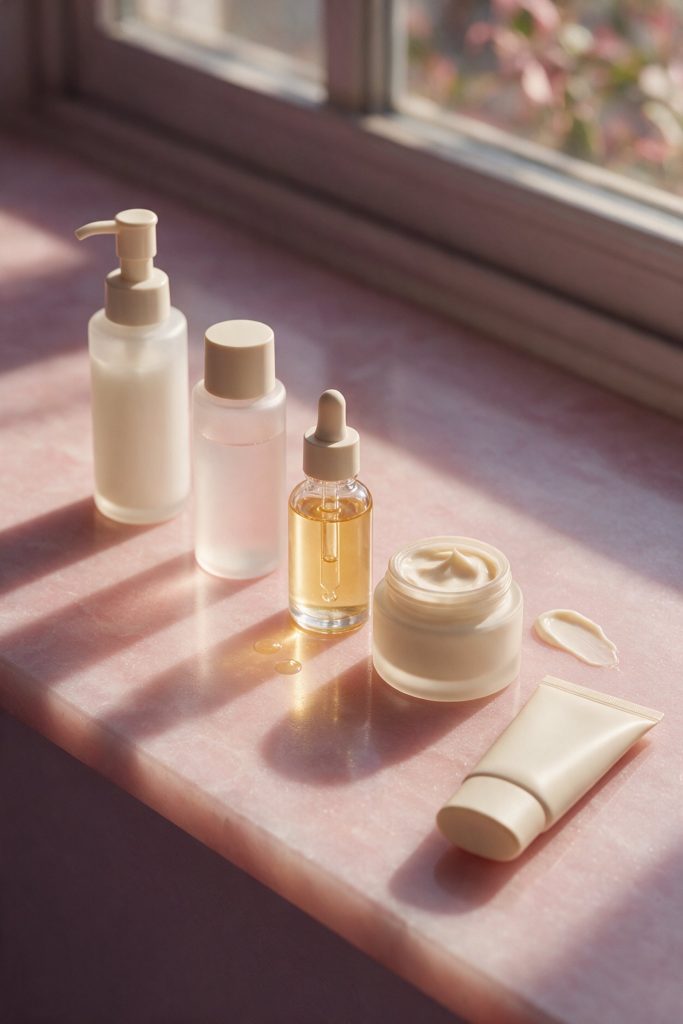
You’ve bought the cleanser, the serum, the moisturiser and the sunscreen. Now the question that stops most people: what goes on first? The order you apply skincare in matters more than it seems. Put a thick cream on before a water-light serum and the serum barely reaches your skin. Put sunscreen under your moisturiser and you dilute the protection you’re paying for.
The good news is that there’s one simple rule behind almost every routine, and once you know it you can slot any new product in without second-guessing.
The Golden Rule: Thinnest to Thickest
Apply products from the thinnest, most watery texture to the thickest and richest. Light, water-based products absorb quickly and need direct contact with skin to work. Heavier creams and oils form a film on top that slows down evaporation, which is exactly what you want from them, but that same film blocks anything you try to layer over it.
There are two exceptions worth remembering:
- Sunscreen always goes last in the morning, even if another product is thicker. It has to sit on the surface to form an even protective layer.
- Prescription or targeted treatments go on clean skin, close to the start of the routine, unless your dermatologist tells you otherwise.
Free: The Peptide Routine Cheat SheetPrint it, stick it on the mirror. AM and PM steps in the right order, plus what layers with what.
Get it freeMorning Skincare Routine Order
Your morning routine is about protection: hydrate, defend against free radicals, and block UV. Keep it short.
- Cleanser. A gentle, non-stripping cleanser, or just water if your skin is dry and you cleansed well the night before.
- Toner or essence (optional). A hydrating toner adds a first layer of water-based moisture. Skip anything with high alcohol content.
- Antioxidant serum. Vitamin C is the classic choice here because it helps neutralise free radicals from sun and pollution. Our vitamin C serum guide explains which forms suit which skin types.
- Hydrating or targeted serum. Hyaluronic acid or niacinamide, if you use them.
- Eye cream (optional). Tap it on with your ring finger before your moisturiser so the richer face cream doesn’t block it.
- Moisturiser. Gel-cream for oily skin, a richer cream for dry skin.
- Sunscreen, SPF 30 or higher. Always the final skincare step. Makeup comes after.
Want the full step-by-step version? See our perfect morning skincare routine.
Evening Skincare Routine Order
At night your skin does most of its repair work, so this is where the stronger actives belong.
- First cleanse (if you wore sunscreen or makeup). An oil or balm cleanser dissolves sunscreen and makeup so your second cleanse can actually clean skin.
- Second cleanse. Your regular water-based cleanser.
- Exfoliant (2 to 3 nights a week). A leave-on AHA or BHA. Don’t use it on the same night as retinol.
- Treatment. Retinol, a prescription retinoid, or azelaic acid. Apply to dry skin to reduce irritation.
- Hydrating serum. Hyaluronic acid, peptides or a soothing serum.
- Eye cream (optional).
- Moisturiser. Often a little richer than your morning one.
- Face oil (optional). Oils seal everything in, so they always go on top of moisturiser, never underneath.
For an anti-ageing focus, our night skincare routine for anti-ageing walks through each step in more detail.
How Long to Wait Between Layers
For most products you don’t need to wait long. Give each layer 30 to 60 seconds, or until it no longer feels wet, before applying the next. That stops products from pilling (rolling into little balls) and sliding around.
There are a few cases where a longer wait helps:
- Retinol on sensitive skin: wait 10 to 20 minutes after cleansing so skin is fully dry. Damp skin absorbs retinoids faster, which can increase irritation.
- Sunscreen before makeup: give it a few minutes to set so your foundation doesn’t disturb the protective layer.
- Hyaluronic acid: the opposite applies. It works best on slightly damp skin, so apply it soon after toner or a spritz of water.
Which Products Should You Not Layer Together?
Most combinations are fine. A handful are best split between morning and evening, or used on alternate nights:
- Retinol and AHAs/BHAs: both increase cell turnover. Together they often cause redness and peeling. Alternate nights instead.
- Retinol and benzoyl peroxide: benzoyl peroxide can break down some forms of retinol and adds dryness. Use benzoyl peroxide in the morning and retinol at night.
- Several strong exfoliants at once: a glycolic toner, a BHA serum and a scrub in the same routine is a fast route to a damaged barrier.
And a couple of myths you can ignore:
- Vitamin C and niacinamide: older studies used conditions that don’t reflect modern formulas. Most people can use them together without issue.
- Peptides and vitamin C: generally fine too. We cover it in detail in can you use peptides with vitamin C?
Where Do Masks, Spot Treatments and Mists Fit?
- Wash-off masks (clay, exfoliating): after cleansing, before the rest of your routine.
- Sheet masks: after toner, in place of a serum. Pat in the leftover essence, then moisturise.
- Spot treatments: on the spot only, after serums and before moisturiser, or on top of moisturiser if it’s a drying formula you want to keep contained.
- Face mists: after cleansing, or on top of makeup during the day. A mist isn’t a substitute for moisturiser.
- Sleeping masks: the final step at night, in place of or over your moisturiser.
A Simple Routine Is Still a Good Routine
Layering order matters, but more steps don’t mean better skin. If you’re starting out, three steps in the morning (cleanser, moisturiser, sunscreen) and three at night (cleanser, one treatment, moisturiser) cover almost everything. Add one new product at a time and give it two to four weeks before judging it, so you can tell what’s helping and what’s causing problems. Our minimalist skincare routine shows how far four products can go.
Adjusting the Order for Your Skin Type
The thinnest-to-thickest rule works for everyone, but which steps you include should depend on your skin.
- Oily or acne-prone skin: keep layers light. A gel cleanser, a niacinamide or salicylic acid serum, a gel moisturiser and an oil-free sunscreen are often enough. Skip face oils. See our oily skin routine.
- Dry skin: add a hydrating toner and hyaluronic acid on damp skin, use a richer cream, and finish with a few drops of oil at night. See our dry skin routine.
- Sensitive skin: fewer steps is better. Introduce actives one at a time and buffer them with moisturiser. See our sensitive skin routine.
- Combination skin: use the same order everywhere, but apply richer products only where you need them. See our combination skin routine.
Skincare Routine Order: FAQ
Does serum or moisturiser go first?
Serum first. Serums are lighter and packed with active ingredients that need to reach your skin. Moisturiser goes on top to seal them in.
Does sunscreen go before or after moisturiser?
After. Sunscreen is the last step of your morning skincare, applied before makeup. Moisturisers with SPF count only if you apply enough, which most people don’t, so a separate sunscreen is more reliable.
Should face oil go before or after moisturiser?
After. Oils can’t carry water-based ingredients into the skin, so anything you put on top of an oil sits on the surface. The one exception is an oil cleanser, which is washed off.
Where does retinol go in my routine?
At night, on clean, dry skin, before your moisturiser. If it stings, try the “sandwich” method: a thin layer of moisturiser, then retinol, then more moisturiser. New to retinoids? Start with our beginner’s guide to retinol.
Do I need a toner?
No. Toners are optional. A hydrating toner can be a nice extra for dry skin, and an exfoliating toner can replace a separate exfoliant, but a good routine works without one.